Wednesday, January 31, 2007

Reading Inside The Lines

Twain


"First they done a lecture on temperance; but they didn't make enough for them to both get drunk on." (Twain, Adventures of Huckleberry Finn, p.356)


Temperance!


Here, Huck is talking about a pair of con men, Duke and King, that are forcibly traveling with him and Jim. The con men are making their way along the river, scamming the people in the villages they pass by and are at it again because they have traveled far enough away from the last place they were caught to start up again. Huck is relaying one of their failed attempts.


This sentence comes only five lines into chapter 31 of Huckleberry Finn and it is one of those lines that wakes you up from the fairy tail of the boy's summer adventure. It's quintessential Twain in that his point isn't superficially apparent, but it's there for the taking. At least something is. There are a few levels of meaning and that quality is another that makes it very Twain as well.

Here Twain is calling attention to the hypocrisy that plagues humanity in his classic humorist style, using Duke and King. Another thing going on here is the temperance movement of the 1800's was picking up steam in the time the Huck Finn was written and within the time frame it was set as well; this line in particular could speak to Twain's ideas about it, but not what side of the movement he was actually for. Finally, as with many of the writers we've looked at thus far, such as Bierce and Harte, this is another signpost that tells the reader that they should examine who the "bad guys" are in the story, and in a larger sense to pay close attention to what's happening.


King and Duke giving a temperance lecture in order to get money to get drunk is not only hypocritical, it's ridiculous. I think that right after that line is where you're supposed to pause for dramatic effect and follow it up with an naive look. If you were telling a humorous story, that is. The problem with humor, especially with a message behind the message is deciphering what that message is. Is it a prod to take all into moderation, including something thought to be good such as temperance? Could it be a reinforcement of why moral issues are legitimate concerns or how ethics fail us? Or could it be really just be a joke? I think, all of the above.


Gin Lane by William Hogarth

Friday, January 26, 2007

The Significance of 241's Agony


Dickinson


241

I like a look of Agony,
Because I know it's true—
Men do not sham Convulsion,
Nor simulate, a Throe—


The Eyes glaze once—and that is Death—
Impossible to feign
The Beads upon the Forehead
By homely Anguish strung.

- Emily Dickinson


In the first stanza, Dickinson writes about the value of agony, or suffering in general. I don't think it is about actually enjoying seeing suffering on the faces of people but rather that it is valuble because it is an authentic human expression - one that can not be convincingly simulated. This idea is extended in the second stanza. The true look of death cannot be fabricated, especially when the death is hard and filled with pain.


This is the poem I always return to whenever I look at Dickinson. I am facinated by it, because it at first seems only a macabre little poem. Then you think about it, because in the 30 seconds it has taken you to read it, it has found a way seep into your mind. That is pretty powerful for a poem with only eight lines!

Knowing more about Emily Dickinson's life, it has become even more powerful and curious. She lead a solitary life - that is what they say, but then, where do these deep observations about life come from? Returning to the idea in the poem - that people are filled with fabrications and masks, disguising their feelings and thoughts from the world, and that there are few exceptions to this; agony and death. How striking is it, that a solitary woman, sitting in her room and peering out at the same landscape day after day, probably at birds and squirrel and trees, articulates this solemn and dark observation of life, and more than that, of human nature. It just knocks me flat, it is phenomenal.


Conversely, another conclusion that the analysis of 241's themes and comparison to the known experiences of Dickinson's life could lead to is that her life just could not have been as solitary as it is presented or thought to have been. Otherwise, would we even need to interact with each other if we could all possibly come up with the same observations without that experience or interaction? It sure takes the wind out of "write what you know."


Friday, December 08, 2006

The Origin of Evil in the House of Usher

Poe


"I looked upon the scene before me — upon the mere house, and the simple landscape features of the domain — upon the bleak walls — upon the vacant eye-like windows — upon a few rank sedges — and upon a few white trunks of decayed trees — with an utter depression of soul which I can compare to no earthly sensation more properly than to the after-dream of the reveller upon opium — the bitter lapse into common life — the hideous dropping off of the veil." (Edgar Allen Poe - The Fall of the House of Usher p. 1535)
(Henry Fuseli’s The Nightmare)


In this passage, the narrator is describing the delaphidated Usher estate and the very strong and unexplainable reaction he feels to it. He attempts to describe what the combination of the two inspire and can only compair it to an expierence of coming off of an opium trip and returning from that euphoric state to a dull, dark and broken reality.

I went back and examined Poe's The Fall of the House of Usher after our class discussion and it seemed an entirely different story to me. In Poe's tale, evil seemes to come from many sources, from nature and from the house itself but its root, the point in which all of the evil in the story converges, is the mind.

Throughout the story, Poe repeadedly alludes that what the narrator is expierencing is not necessarily based exclusively in reality. Many times the narrator isn't able to express exactly what is bothering him about a particular thing as with his first sight of the Usher house. "I know not how it was - but, with the first glimpse of the building, a sense of insufferable gloom pervaded my spirit." (p. 1534) It's clear that the narrator is feeling deeply gloomy, but he isn't able to describe what is making him feel that way. Later in the story, the narrator says that he will never forget the many hours he spent in the house with Roderick, but that "[he] should fail in any attempt to convey an idea of the exact character of the studies, or of the occupations, in which he involved me..."(p. 1539) The fact that the narrator is missing this information - that he is unable to recall any details or describe with any certainty the nature of what troubles him alludes to the idea that his expierences my not be entirely real or taken a step further, completely in his mind. Both of these passages are laced with language of a dark and evil mood - "insufferable gloom" and a "pervaded spirit" have evil connontations and in the later passage, the narrator describes this memory of time spent with Roderick as a "shroud" which makes an allusion to death and in this case, (as one wouldn't usually bear the memory of spending time with some one as a "shroud") also has evil connontations. When coupled with the idea that both of these passages not only describe dark and evil feelings, but that they are completely rooted in the narrators mind, you can see how Poe brings the two together to craft a picture of the mind as the origin of evil.
The narrator isn't the only place we see evidence for Poe's intentional implications to the mind as the origin of evil in The Fall of the House of Usher. In a contrasting moment for the narrator, one of the details he can remember is of a "verbal improvisation" (p.1540) Roderick performs in the form of a poem or song. "Snow-white palace — reared its head. /In the monarch Thought's dominion —/It stood there!" (p. 1540) This poem being one of the only solid details that the narrator remembes serves as an emphisis for its importance in the story. In these lines, it states that the kingdom is under "Thought's" dominion and that is where it stands - in thought or the mind. Later the poem describes a scene in the kindom where "A troop of Echoes whose sole duty/ Was but to sing . . ./The wit and wisdom of their king."(p.1541) In these lines, the Echoes can be explained as those of the mind.
(Henry Fuseli’s The Nightmare [Frankfurt Version])
Here you see an interation that mirrors the insanity of Roderick and the narrator himself - echos symbolizing past thoughts being re-"sung" and nothing more than shadows of the king's mind (as his "wit and wisdom") but also personifies the echoes as people - tangible, reality based interaction, linking it directly to the story. The narrator says that the title of Roderick's poem is "The Haunted Palace" (p. 1540) Poe is drawing a clear parallel between the story and the poem, thereby alluding to the idea that what is happening to the narrator and Roderick is also in the kingdom of thought. Poe uses the trappings of mental instability as a device to illustrate evil in Usher again, pointing to the mind as the origin of evil.
Throughout Usher we see the mental breakdown of Roderick as well as the effective pacifiation of the narrator which ultimately allows Roderick to go unchecked by anyone. By the end of the story, we know that it is Roderick's actions that lead to the supernatural fall of both the metaphoric and material House of Usher. Through Roderick's insantity, shared in part (or maybe even in full) by the narrator, horror and evil are depicted and Poe gives demonstrates how the mind itself can be a source of evil.

Friday, December 01, 2006

Love Him / Shove Him

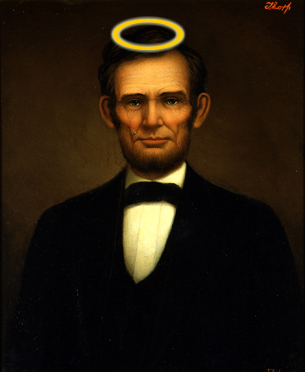
LINCOLN


Love Him / Shove Him


"Lincoln committed himself to the elimination of slavery throughout the country by degrees. Initially, he wished only to contain it; then he say that "a house divided against itself cannot stand," and he proceeded cautiously, with the Emancipation Proclamation . . . finally, he took the leading role in the passage of the Thirteenth Amendment, which outlawed slavery everywhere and forever in the United States." ( Nina Baym, pg. 1609, The Norton Anthology of American Literature, "Abraham Lincoln")


The editor of Norton is saying that it took ol' Mr. Lincoln a while to come around to fully embracing the total abolition of slavery. He was pushed further into the direction because of his realization that having two stances on slavery was going to rip the union of the states apart. He ultimately ended up spear-heading the passing of the Thirteenth Amendment.


I've been thinking about Abe since Wednesday. It's a tough one. As a woman of color, and just as someone who thinks that slavery is plain wrong, it is troubling that Abe wasn't really about ending slavery - he was about preserving the union. Despite that, he does deserve credit for taking a stand eventually and doing the right thing by passing the Emancipation Proclamation as well as the Thirteenth Amendment for whatever reason he did it.


I don't agree that he was just another fake, placating, politician out to cover his own butt. He may not have been about abolishing slavery, but he realized that things wouldn't work they way that they were, that there was going to be a fight, and once he realized that, he took a stand. The seeds of civil war had long been planted by the time Lincoln got around to being president.


I feel that he was the only person who could've been president during the Civil War. The nation needed a leader that was conscientious of the needs of the nation and of the fact that on the issue of slavery, the right choice was abolition. It should be noted that things usually aren't very simple and that even when it seems there is a clear right and wrong choice, the fallout of those choices still must be contended with. Being president meant that whatever decision you make, it isn't just a personal one, it's about the country - besides, who wants to be the president who killed America? There must have been an infinite amount of pressure, I can't even imagine. In friendship, I don't know that I would be cool with Abe. As a president, you want the person who can make the decision that is in the best interests of the nation and I think he tried his hardest to do that. I get the impression that he truly thought about slavery and what it meant for the future of the nation and that he deeply struggled with it; I respect that.


"With malice toward none; with charity for all; with firmness in the right as God gives us to see the right, let us strive on to finish the work we are in; to bind up the nation's wounds; to care for him who shall have borne the battle, and for his widow, and his orphan - to do all which may achieve and cherish a just and lasting peace, among ourselves and with all nations." ( Abraham Lincoln, Second Inaugural Address)


I believe that his Second Inaugural Address supports the idea that Lincoln wasn't perfect, but he wasn't horrible either. In the last paragraph of his address, he talks about charity, healing and peace. This should've been his "Ha, I was right, I won, suckers!" moment, but instead, he took the opportunity to share his grief over the war. The whole thing seems seeped in guilt and sadness. He doesn't call for punishment - he says we've all been punished by the war. By not singling out either the North or the South, he gives the idea that as a nation we were collectively wrong. He calls for "firmness in the right as God gives us to see the right, ..." saying that not only were we all in the "wrong" but that none of us will unfailingly be the bearers of what is right and that we need a higher power to assist us. Those simply don't seem like the words of a man that is only in it for damage control.


Lincoln may have not cared about slavery, or even African Americans, but he still managed to do great work and you can't argue with that. Besides, everyone is a jerk if you look close enough.


Givin' The Ol' Man the What For

BEECHER STOWE


" 'You oughtenter wish that to any human crittur. '
[...] 'Lor, if the devil don't get them, then what's he good for?' And Anunt Chloe covered her face with her checked apron, and begain to sob in good earnest
'Pray for them that 'spitefully use you, the good book says,' says Tom.
'Pray for 'em!' said Aunt Chloe; 'Lor, it's too tough! I can't pray for 'em.' " (Harriet Beecher Stowe, Uncle Tom's Cabin)

This is an exchange between Tom and his wife, Chloe. Here Tom has over heard a conversation that Chloe is having with little Jake and Andy about Mr. Haley and slavers in general. Tom overhears Jake and Andy say that they wish that they would burn in eternal damnation (or go to hell forever :o)). This quote opens with his chastisement of the boys for saying that and following is Chloe's interjection and response to Tom's disapproval. Tom thinks that wishing someone to damnation is wrong and is so terrible that it shouldn't be wished on anyone, not even slavers. Chloe disagrees with Tom and flatly says that if damnation isn't for people like the slavers, then hell isn't serving its purpose. Tom responds with a quote from the bible essentially saying to be merciful to people who are cruel and to not be so judgmental to which Chloe retorts that it is too difficult not to judge them and wish good for them.

This is an awesome exchange. Chloe saying "Lor, if the devil don't get them, what's he good for?" has got to be my favorite quote of the whole piece. Chloe is asserting her opinion as valid she is calling Tom out on his inability to stand up for himself and it's incredibly funny. This is a moment in the book where the exchange isn't as high-melodrama as it is in other places (although there is the crying.) and Chloe's reaction seems genuine; what is hell and the devil good for if it isn't for punishing bad people? That's what I thought the concept of hell was all about.

Fun bits aside, the real reason I wanted this to be my quote for this entry is that it is an example of one of the reasons why I think Uncle Tom's Cabin is valuable in feminist literature. This exchange between Chloe and Tom is just one of the many points in the book where the women of the book assert themselves. They all have their own opinions and thoughts and they freely and fearlessly express them. All the women in Uncle Tom's Cabin aren't necessarily wonderful characters, but each of them do what they feel is right when the time comes. Women have a very central and dominate role in this book.

"You ought to be ashamed, John! Poor, homeless, houseless creatures! It's a shameful, wicked, abominable law, and I'll break it,for one, the first time I get a chance; and I hope I shall have a chance, I do!" (Beecher Stowe, Uncle Tom's Cabin)

Here, Mary Bird is laying into her husband Senator John Bird for voting for the Fugitive Slave Law. She is not only expressing her opinion of the law, but chastising her husband for his role in passing it; more than that, she is boldly announcing her opposition to her husband and her intentions to disobey a law he helped to pass. It is amazing to see these type of exchanges because they aren't common place. Obviously it should be said that Stowe's own opposition to the Fugitive Slave Law clearly played a role in this passage, but she did choose a woman to express her feelings, where she could have very easily had a man express it. I think that is powerful and important to notice. One other thing is that this exchange parallels the one that Chloe and Tom have, illustrating the connections between the two groups as well as validating the relationships and ideas of black women.

Something else that is interesting is the role that men play. Stereotypically, men are supposed to be forceful and assertive. There isn't a lack of those sort of men in Uncle Tom's Cabin rather, there is a presence of men who aren't all about stereotypical male gender. Tom is a good example of this. He is gentle and nurturing. He is a caretaker for Eva and for people in general. St. Clare also exhibits some non-alpha male behavior when dealing with Ophelia. St. Clare buys Topsy for Ophelia. Sure, he is trying to show her that her racist feelings are wrong, but he is doing it in a way that caters to her. He isn't going around, bellowing and enforcing his ideas on her - instead he's come up with a way to prove his beliefs.


That Harriet is pretty cool.


Monday, November 27, 2006

The Adventures of Huckleberry Finn in Uncle Tom's Cabin

Harriet Beecher Stowe
Mark Twain

BEECHER STOWE
"Tom had often caught glimpses of this little girl, - for she was one of those busy, tripping creatures, that can be no more contained in one place than a sunbeam..."
(Harriet Beecher Stowe - Uncle Tom's Cabin)


I think that the quote's meaning is self explanatory, just describing Eva and maybe a bit of her personality. It says that Eva is a good natured, curious and a little bumbling girl with lots of energy.


TWAIN


The reason I bring it up, may also be pretty obvious, especially given the illustrations I found. I realize that Mark Twain's The Adventures of Huckleberry Finn is generally about something entirely different than Harriet Beecher Stowe's Uncle Tom's Cabin these two sets of characters - Stowe's Eva and Tom and Twain's Huck and Jim are astoundingly similar. They are almost the exact same with two exceptions; Eva and Tom are essentially more "good" than Huck and Jim and Eva and Huck are the opposite sex to one another. I say that Eva and Tom are "good" because Tom is obediently with his owner and Eva is adventurous but doesn't misbehave the way Huck does.


The fundamentals are there though! Both are a benevolent relationship between an adult slave and a well meaning child. Both slave men play a guardianship role in the child's life but are also their friends and in a way they are set as their peers in the sense that as they are slaves are "beneath" the white adults and are paid attention to as much as one would a child. Both sets of characters are even traveling down the Mississippi River!


I think this speaks to the level of influence that Beecher Stowe had on Twain. I say Stowe influenced Twain because Uncle Tom's Cabin was published in 1851 and Twain didn't publish The Adventure's of Huckleberry Finn until 1884, a full 33 years later! Though I wonder if it wasn't more of a tribute or nod from Twain to Beecher Stowe, especially in light of the similarities between the two sets of characters.


Side note: it's annoying to find yet another example of how women get a raw deal with this sort of thing. Everyone and their dog knows Huck and Jim, but outside of academics, I bet you couldn't find 10 people on the street who know who the heck Eva and Tom are.

Friday, November 10, 2006

Why I Hate to Love Emerson

EMERSON


"But let us deal with them greatly; let them make their way by the upper road, and not by the way of manufacturing public opinion, which lapses continually into expediency, and makes charlatans. All that is spontaneous is irresistible, and forever it is individual force that interests. I need not repeat to you,--your own solitude will suggest it,--that a masculine woman is not strong, but a lady is. " (Emerson, "Woman")


I've taken this from an address Emerson delivered entitled "Woman". Seems to me that he is saying that men should be nice to women and that they should provide separate avenues for women to pursue their interests and influence society. He goes on to say that this is what women want, they don't want to "dirty their hands" so to speak with politics because it will damage them and masculate them, which is undesirable. Taking a full role in politics detracts from their womanhood and that is unattractive.

I am so disappointed. I truly am. While I think it is way too strong to call Emerson a misogynist, (I don't see any evidence for that at all.) he is not completely on the side of women. I read this address and I can't believe that he wasn't booed off of the stage. He doesn't grasp the idea of equality completely - that want to take their place as true equals. He seems to be taking a "separate but equal" stance - that women have their role in society, and men have theirs and that a woman that would seek to realize her role and influence in society in the same manner as a man isn't as powerful and the very act detracts from her value and virtue. AHHH! On the flip side of this, what makes it okay that the men are made into "charlatans"? The whole idea he is expressing is that women can't take it - they are too delicate. This very idea is sexist in that it still puts women in a "less than" position. He misses the point, and maybe a lot of other people did as well at the time. Still, what is confusing is that he says this after earlier in the address he says:

"One truth leads in another by the hand; one right is an accession of strength to take more. And the times are marked by the new attitude of Woman; urging, by argument and by association, her rights of all kinds, in short, to one-half of the world;--as the right to education, to avenues of employment, to equal rights of property, to equal rights in marriage, to the exercise of the professions and of suffrage. " (Emerson, "Woman")


Here he is saying that strengthening the rights of women strengthens everyone. And goes on to have a solid stance that women should have equal rights to general institutions and tangible items. I find myself frustrated an confused. He publishes and supports essays like Fuller's "The Great Lawsuit" in The Dial but then he gets right on up and says, "yes, women need rights, but let's not kid ourselves, they can't take being political like men can - we should protect the delecate things!" What in the world is that? I can't completely decide if Emerson is against women having FULL equal rights (including their societal roles) and thereby just not getting the concept or if he is against it because he is against politics in general, which would follow the pattern in his life. I don't see how he could be good friends with people like Margaret Fuller and Wendell Phillips or even Thoreau with the lack of follow though. I suppose the point of this, is that I love his work otherwise, but I can't really respect him on the point of "the woman question". His participation in the movement seems obligatory at best and it's hard to reconcile his ideas of the equality of men and slavery and those he held for women's rights. However, his level of participation seems to go along with his general principles and disposition and I do respect him for that.


Wednesday, October 11, 2006

Scary Words in the Hands of an Angry Minister

Jonathan Edward
"Sinners in the Hands of an Angry God"


"There is laid in the very nature of carnal men a foundation for the torments of hell. There are those corrupt principles, in the reigning power in them, and in full possession of them, that are seeds of hell fire. [ ... ] The corruption of the heart of man is immoderate and boundless in its fury; and while wicked men live here, it is like fire pent up by God's restrains, whereas if it were let loose, it would set on fire the course of nature; ... it would immediately turn the soul into a firey oven, or a furnacne of fire and brimstone."


Here, Edwards states that "unsaved" people are naturally on a path of destruction. Their principles are weak and they are completely governed by their impulses alone. This complete deference to desire is overwhelming in people, but is still somewhat restrained by God. If God weren't holding it back, it would fully consume them.


I found this particular quote striking because it reveals a bit of the struggle that Edwards himself went through. He admits in his "Personal Narrative" that he struggled with complete piousness and that he many times returned to living "...In the ways of sin." (Personal Narrative, P. 466) In this passage, you are able to see a bit of the philosophy that Edwards developed around the nature of people and sin. This passage illustrates his belief that it was in people's nature to live in what he considered sin. Coupled with his admission of repeatedly back-sliding himself, you are able to see how his faith and experience had led him to his conclusions on human nature.


Something else this reveals is the sort of language and style that Edwards liked. This passage is full of strong, passionate "fire" words. Each sentence contains either a very strong word closely linked with fire or an actual alternative form of fire. "Fury" and "hell" and "fiery oven" Edwards drives his imagery into your mind over and over again with these words, you can practically imagine someone spontaneously combusting in the church!


The peek into Edwards' mind and philosophy coupled with the explosive imagery make this particular passage stand out.